Adaptive Incentive Models Responding to Engagement Patterns in Hybrid Casino-Sports Platforms
Drew Fischer · Aug 4, 2026

Adaptive Incentive Models Responding to Engagement Patterns in Hybrid Casino-Sports Platforms
Hybrid casino-sports platforms track user interactions across betting markets and slot sessions through integrated analytics systems that capture session duration, wager frequency, and cross-category shifts in real time. These systems generate datasets that feed directly into incentive engines designed to adjust reward parameters based on observed behavior clusters. Operators in markets such as Australia and Canada began rolling out such engines at scale during the first half of 2025, and by August 2026 deployment had expanded to additional jurisdictions where regulatory frameworks permit dynamic personalization.
Mapping Engagement Signals
Platforms collect telemetry on login intervals, stake sizes per category, and migration between live sports events and casino titles. Researchers at the University of Nevada Reno documented how sequences of high-frequency sports bets followed by casino autoplay sessions correlate with specific retention windows. Their 2025 working paper outlined algorithms that classify users into segments such as event-driven participants or steady-volume players. Those classifications trigger tailored credit multipliers or free-spin allotments that recalibrate every 24 to 48 hours.
Data from the Canadian Centre on Substance Use and Addiction indicates that platforms applying these segmented adjustments recorded measurable differences in average daily active users compared with static bonus schedules. The adjustments operate through rule sets that increase or decrease reward density according to detected drops in cross-platform movement rather than blanket volume targets.
Mechanics of Real-Time Adaptation
Adaptive models rely on decision trees and reinforcement learning loops that ingest fresh telemetry at fixed intervals. When a user’s sports betting activity declines while casino play remains constant, the system may surface accumulator boosts tied to upcoming matches or shift toward deposit-match percentages that favor table games. Conversely, an uptick in live-sports in-play wagers can prompt the release of risk-free bet tokens calibrated to the user’s historical stake range.
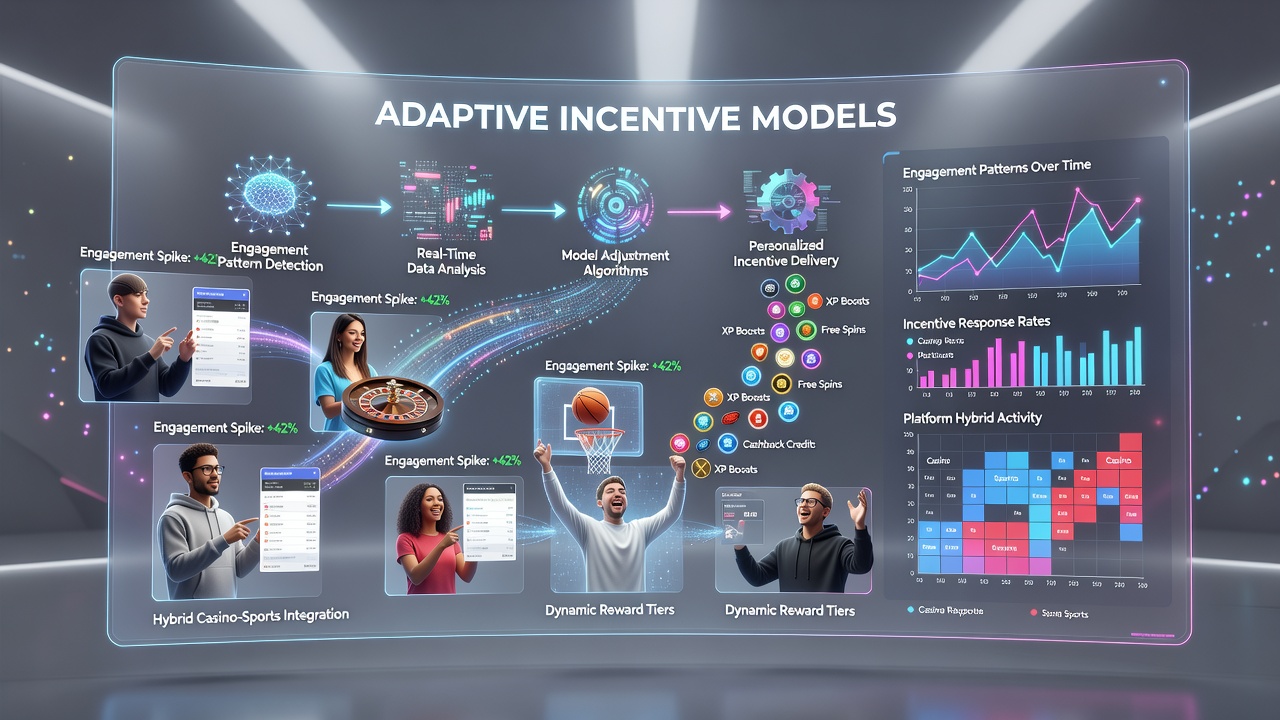
Implementation details vary by jurisdiction. Operators licensed in Ontario must log every parameter change and retain audit trails for 90 days under the Alcohol and Gaming Commission of Ontario rules. Similar record-keeping requirements appear in the Northern Territory of Australia, where the Racing Commission mandates disclosure of personalization criteria upon request. These compliance layers add latency to model updates yet do not prevent daily recalibration.
Observed Outcomes Across Markets
One European operator group reported that its hybrid application in Spain and Italy achieved a 14 percent lift in weekly session count after introducing pattern-responsive free-bet ladders during the 2025-2026 La Liga and Serie A seasons. The ladders reset based on consecutive days of mixed activity rather than fixed calendars. A separate North American deployment covering Major League Baseball and online blackjack recorded comparable increases in cross-category play when incentives shifted from generic deposit matches to event-specific cashback tied to individual betting histories.
Academic observers note that the timing of these adjustments matters. Models that react within the same day of a detected engagement dip outperform weekly batch updates. The difference appears in metrics such as return visits within 72 hours and average revenue per user across both verticals. Platforms that publish anonymized aggregate statistics, such as those referenced in reports from the Australian Gambling Research Centre, show consistent patterns of higher multi-category participation when incentives follow real-time signals.
Regulatory and Technical Considerations
Regulators in multiple regions require transparency around how user data informs reward allocation. The Alcohol and Gaming Commission of Ontario and the Northern Territory Racing Commission both mandate that operators disclose the primary data fields used for segmentation. Technical teams therefore maintain separate data pipelines for regulatory reporting and for the adaptive engines themselves. Encryption standards and access controls prevent direct linkage between identifiable accounts and model training sets.
August 2026 saw several platform providers release updated software development kits that embed these compliance checks at the point of reward generation. The kits allow operators to toggle between jurisdictions without rewriting core logic, a feature that reduces development overhead when entering new markets.
Conclusion
Adaptive incentive models in hybrid casino-sports environments continue to evolve through iterative refinement of engagement signals and compliance safeguards. Platforms operating under frameworks established by bodies such as the Alcohol and Gaming Commission of Ontario and the Australian Gambling Research Centre demonstrate that real-time parameter adjustments can sustain participation across both verticals when supported by transparent data practices. Ongoing documentation of these systems provides the factual basis for further development through the remainder of 2026 and beyond.